Most people who book a boudoir shoot worry about the same thing: I will not know how to pose. Good news, you do not need to. Posing is my job, and I guide you through every frame. Still, it helps to know what is coming, so here are the poses I use most often, why they work, and the small adjustments that turn an awkward position into a beautiful one.
Why posing matters less than you think
A pose is just a starting shape. What makes a boudoir photo work is what happens inside it: a relaxed jaw, soft hands, a breath out, a glance that lands somewhere real. That is why I talk you through each pose rather than showing you a diagram and stepping back. Tiny changes, a shoulder dropped by a centimetre or a chin brought forward, make a bigger difference than the pose itself.
It also means every pose here can be adapted to your body, your mobility and your comfort. If something does not feel good, it will not look good either, so we change it.
Poses on the bed
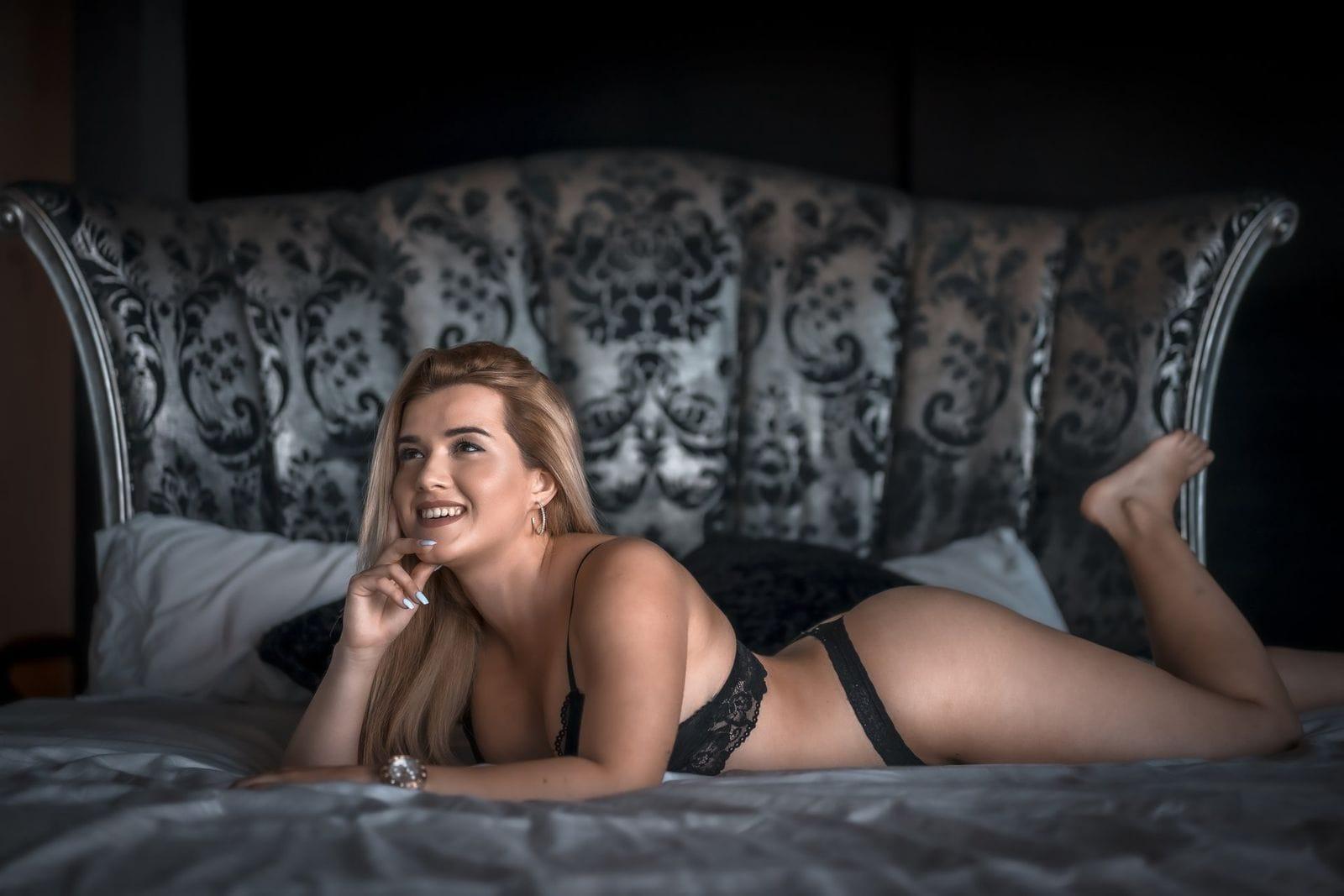
Lying on your front, feet up. Lie on your stomach facing the camera, prop yourself on your forearms and let your lower legs float up behind you, crossed at the ankle. It is playful, it is easy to hold, and it naturally brings your face forward and closer to the light. Laughing in this pose almost always produces a favourite.
Lying back, arms overhead. On your back across the bed, let your hair spread out and rest your arms loosely above your head. Bend one knee slightly and roll the hip a touch towards the camera. Shot from above, this pose lengthens the whole body and looks effortless.
On your side, back to the camera. Lie on your side facing away, with the curve from shoulder to waist to hip catching the window light. Turn your head slightly over your shoulder or not at all. It is one of the most flattering boudoir poses there is, and a gentle way to start for anyone feeling shy.
Legs up the wall. Lie on your back near the head of the bed and rest your legs up against the wall, ankles crossed or toes pointed. It sounds odd and looks lovely, especially for showing off heels or stockings.
Seated poses
On the edge of the bed. Sit near the edge with your weight shifted onto one hip, knees together and angled away from the camera. Bring one hand up to rest on the opposite shoulder or collarbone. Sitting tall, then letting your shoulders soften, keeps this pose from looking stiff.
On the floor against the bed. Sit on the floor with your back against the bed or a chair, knees bent and drawn up, and lean an elbow on the mattress behind you. It is grounded and relaxed, and it works beautifully in afternoon sun or window light.
Curled in a chair. A deep armchair is a gift. Drape your legs over one arm, lean back into the other, and let one hand rest in your hair. It reads as confident without trying too hard.

Standing and window poses
Leaning on a frame. Lean a shoulder against a doorway or window frame, put your weight on your back leg and bend the front knee slightly across the body. The angle creates shape at the waist and hip, and the frame gives your hands somewhere to go.
Silhouette against the curtains. Stand or kneel between the camera and a bright window so the light outlines you. Very little detail shows, which makes it one of the most discreet and dramatic options, and a good choice if you want a more covered image that still feels sensual.
Kneeling poses
Kneel on the bed, sitting back slightly on your heels, and lift your hands into your hair. Facing the camera, it is strong and open. Facing away, with your head turned towards the window, it becomes soft and private. Kneeling also lets me shoot from a lower angle when you want a pose that feels more powerful.

The small details that make a pose
These are the adjustments I give most often during a shoot. You do not need to remember them, but they explain why I keep asking for tiny changes.
- Chin forward and slightly down. It defines the jawline and feels strange, which is how you know it is working.
- Space between arm and body. Arms pressed flat against the body widen them. A small gap shows your shape.
- Soft hands. Rest them lightly, fingers relaxed, never flat or clenched.
- Point your toes. Even when your feet are barely in the frame, it lengthens the legs.
- Breathe out. Holding your breath shows in your shoulders and face. A slow exhale just before the shutter softens everything.
- Look away, then back. Glancing away and returning to the lens on a count of three gives a far more natural expression than staring straight in.
Posing for different bodies
Everything above works for every body, with small changes. For curvier clients, I often shoot from a little higher, turn the body slightly away from the camera and use fabric, a sheet or a shirt, to add shape and movement. For taller clients, seated and lying poses make the most of long lines. For anyone with limited mobility or a sore back, there is always a version that keeps you comfortable.
If you want more on that, the guide to boudoir for every body covers plus size, over 40, maternity and male boudoir. And if the question on your mind is what to wear in all these poses, read what to wear to a boudoir shoot.
How to prepare, without over-preparing
Save a handful of images you love and bring them to the consultation. They tell me more about the mood you want than any description could. If you like, spend five minutes in front of a mirror trying the seated and lying poses so they feel familiar. Then stop. Over-rehearsed poses tend to look rehearsed.
On the day, all you need to do is turn up and listen. You will be guided through every frame, shown the back of the camera often, and never pushed towards a pose you are not ready for. See how a boudoir session in Wellington works, or get in touch to start planning yours.